



We like to think we are careful. We check our locks, we set strong passwords, and we try to do the right thing. But when work gets busy or life gets chaotic, small details slip through the cracks. A sticky note with a password gets left on a monitor. A bank statement ends up in the kitchen trash instead of the shredder.
These tiny slips are where significant problems begin. While sophisticated hacking attempts grab headlines, simple mistakes by well-meaning people are often the real cause of security breaches. This is why relying solely on memory or individual judgment is risky. Instead of asking people to be perfect every day, businesses and homeowners need a system that works automatically.
Scheduled shredding acts as that proactive system. It stops being a task you have to remember and becomes a background process that just happens. By removing the need for daily decisions about what to keep and what to destroy, you protect your information from the most unpredictable variable in security: human error.
Understanding Human Error in Data Protection
When we talk about “human error,” we aren’t usually talking about negligence or malice. We are talking about fatigue, distraction, and simple forgetfulness. In the context of document security, this manifests in ways that seem harmless at the moment but have serious consequences.
Common examples include:
- The “I’ll do it later” pile: Stacking sensitive files on a corner of a desk intending to shred them Friday, only to forget for three weeks.
- Recycling confusion: Throwing a confidential contract into the blue recycling bin because it “doesn’t look that important.”
- Unattended documents: Leaving a client file on a printer tray or a meeting room table.
Even the most highly trained teams make these mistakes. Training sessions fade from memory, but a bad habit sticks. Without a physical system in place to guide behavior, human error in data security remains a persistent threat.
What Scheduled Shredding Actually Is
The concept is straightforward. Instead of calling a truck only when your storage room is overflowing, a shredding provider comes to your location on a set rotation—weekly, bi-weekly, or monthly.
This service differs significantly from a one-time purge. A purge is an event;
scheduled service
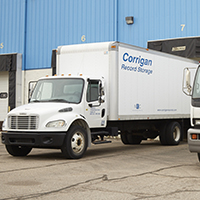
is a routine. The provider places secure, locked consoles or bins in your office or home. You deposit papers into these consoles daily. On service day, the professional driver empties them, destroys the contents immediately, and the cycle starts over.
Who benefits most from this?
- Offices with daily paper flow: Law firms, accounting practices, and HR departments.
- Medical facilities: Places handling patient records daily.
- Home offices: Remote workers managing corporate data from their spare room.
How Scheduled Shredding Reduces Human Error
The genius of this approach lies in its simplicity. It tackles the root causes of error—decision fatigue, laziness, and forgetfulness—by changing the environment.
Removes Decision Making From Employees
The biggest hurdle in data protection is the split-second decision: “Is this piece of paper confidential?” If an employee has to stop and analyze every scrap of paper, they will eventually get tired and guess wrong.
With a scheduled service, the policy becomes simple: Shred everything. You don’t need to check for a social security number or a signature. If it’s paper, it goes in the console. This eliminates reliance on judgment calls that vary from person to person.
Creates Consistent Secure Habits
When a
secure console
is sitting right next to the copier or the desk, using it becomes a reflex. It is easier to slide a paper through the slot than to walk it down the hall to a noisy office shredder that might be jammed.
These consoles prevent document buildup. There is no pile of “to-be-shredded” papers waiting for a free moment that never comes. The moment a document is no longer needed, it is secured.
Reduces Shortcuts and Workarounds
We have all seen it happen. The office shredder is full, jammed, or overheating. An employee, in a rush, tosses a sensitive draft into the wastebasket just this once.
Document shredding services that operate on a schedule remove these obstacles. The equipment doesn’t jam because the employee isn’t the one doing the shredding. The bin doesn’t get too full because it is emptied regularly. By making the secure option the easiest option, you drastically reduce risky shortcuts.
The Role of Process Over Policy
Writing a strict security policy is necessary, but a policy is just words on paper. A process is what actually happens. You can tell employees to be careful a thousand times, but if the physical workflow is difficult, compliance will drop.
Scheduled service aligns your daily operations with privacy regulations without requiring extra effort from staff. It supports compliance naturally. When the auditor asks how you handle sensitive waste, you don’t show them a manual that nobody reads; you point to the locked consoles and the service logs. This bridges the gap between what you say you do and what you actually do.
Scheduled Shredding and Accountability
Trust is good; proof is better. When you shred documents yourself using a store-bought machine, there is no record of it. If a client asks if their file was destroyed, you can only give your word.
Professional destruction provides a chain of custody. From the moment the paper leaves your office to the moment it is destroyed, the process is tracked.
- Secure collection: Uniformed staff handle the bins.
- On-site destruction: You can often witness the shredding happen at the truck.
- Certificate of Destruction: After every service, you receive legal proof that the materials were destroyed.
This documentation builds trust with clients, customers, and regulators. It proves you take human error in data security seriously enough to invest in verified destruction.
Benefits Beyond Security
While security is the main driver, the operational benefits are substantial.
- Saves time: Staff members stop wasting hours removing staples, paperclips, and feeding paper into slow machines.
- Reduces clutter: Paper piles are a fire hazard and an organizational nightmare. Regular removal keeps the workspace clean.
- Predictable routine: You know exactly when the truck is coming, which supports long-term planning and budgeting.
When Scheduled Shredding Makes the Most Sense
While almost everyone generates some paper, this service is particularly vital for:
- Growing teams: As you add people, the volume of paper—and the risk of error—multiplies.
- High document turnover: Industries that print, sign, and file daily.
- Regulated industries: Healthcare, finance, and legal sectors where a breach means heavy fines.
- Businesses recovering from an incident: If you have had a scare, this is the fastest way to close the security gap.
Final Thoughts
Most data breaches do not start with a sophisticated cyber-attack. They start with a mistake. They start with a tired employee, a jammed shredder, or a misunderstanding about what is considered confidential.
Good intentions are not a security strategy. Systems are. By implementing a routin