

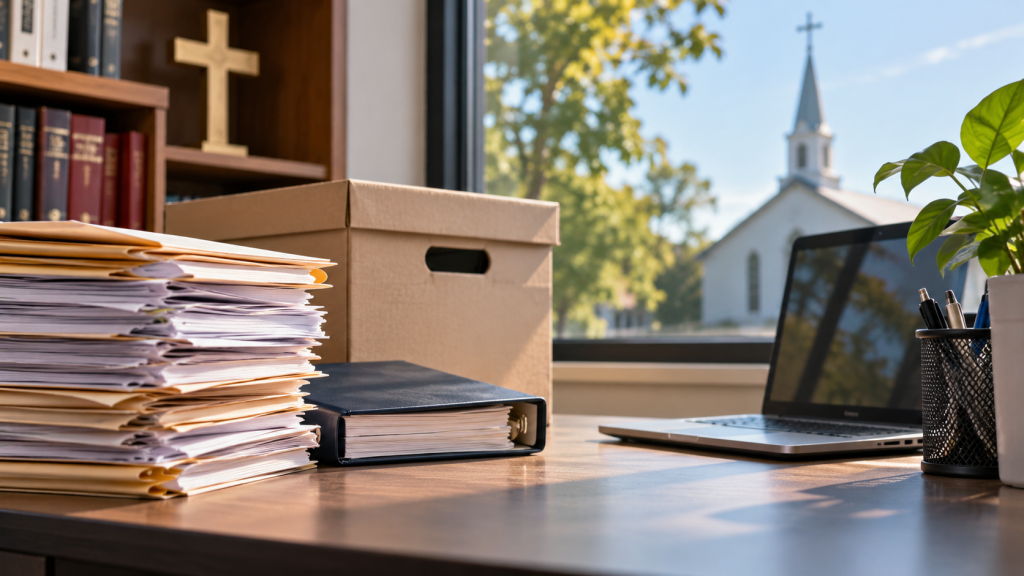
Most churches have a room nobody likes to open. It’s full of boxes of old giving records, committee minutes, staff files and decades of registers.
Good church records management means knowing what is in those boxes, protecting what can never be replaced and safely destroying what is no longer needed. Here are six problems churches run into, and practical ways to solve each one.
What Records Does a Church Need to Keep?
A church needs to keep some records permanently, such as its registers and meeting minutes, and keep others for a set number of years.
Most churches handle some mix of the following:
- Registers of baptisms, marriages, funerals and membership
- Board, council and committee minutes
- Giving records, offering envelopes and contribution statements
- Bank statements, canceled checks and payroll records
- Staff personnel files and volunteer applications
- Deeds, building plans and insurance policies
The exact rules depend on your denomination and your state, so it’s worth checking with both your denomination’s archives and your accountant.
6 Church Records Management Problems
1. Irreplaceable Registers Are Stored in a Basement
Registers record a congregation’s history. They are also often kept in a basement closet or an old filing cabinet.
One burst pipe or a damp summer can ruin them. Moving the originals into climate-controlled, fire-protected vault storage protects them, and a scanned copy gives the church a backup.
2. Nobody Knows What’s in the Boxes
Church offices see a lot of turnover. Pastors move on, secretaries retire and volunteers change roles.
Every change makes the storage room a little more of a mystery. An inventory, and a move to off-site storage with a web-based tool for requesting files, means the next person can find records without digging.
3. Giving Records Pile Up Year After Year
Offering envelopes, check copies and contribution statements contain names, addresses and sometimes bank details. Many churches keep all of it, forever, because no one is sure when it’s safe to throw out.
Once those records pass the church’s retention period, they should be shredded, not recycled. One-time shredding clears years of old financial files in a single visit.
4. Staff and Volunteer Files Hold Sensitive Information
Personnel files and volunteer applications can include Social Security numbers, background check forms and contact details. These files are often stored in the same unlocked room as everything else.
They belong in secure storage while the church needs them, then in the shredder when they no longer do.
5. Boxes Take Over Classrooms and Offices
Space is valuable in a church building. When records spill into classrooms, closets and the pastor’s office, that space can’t be used for ministry.
With off-site document storage, the boxes leave the building but stay within reach. Corrigan offers two-hour rush delivery when a file is needed quickly.
6. Finding One Old Record Takes Hours
A former member needs proof of a baptism. A family asks about a funeral from 1974. Someone has to dig through handwritten books to find the answer.
Document scanning turns those pages into searchable digital files. Staff can find a record in seconds, and the fragile original stays protected.
Church Records: What to Keep and Where to Put It
This table uses the Presbyterian Historical Society’s general schedule as an example. Your denomination’s schedule may differ.
| Record | How long to keep | Best option |
| Registers and minutes | Permanent | Vault storage, plus a scanned copy |
| Weekly donation records, canceled checks, bank statements | 7 years | Off-site storage, then shredding |
| Bank deposit slips | 3 years | Off-site storage, then shredding |
| Personnel records | 7 years after employment ends | Secure storage, then shredding |
| Architectural drawings | Permanent (one copy) | Large format scanning and storage |
How Corrigan Helps Churches Manage Their Records
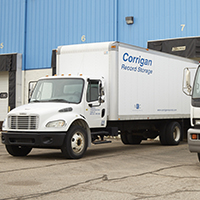
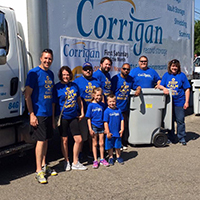
Corrigan Record Storage is a family-run Michigan business that has provided shredding and storage services since 1987. The company operates 10 facilities and serves Detroit and Southeast Michigan.
Its storage facility is gated, alarmed, climate-controlled and monitored by video surveillance. Corrigan also offers scanning for standard and oversized documents, including building plans and architectural drawings.
When records are ready to be destroyed, Corrigan is AAA NAID Certified and provides a certificate of destruction to every customer.
Frequently Asked Questions
Should a church scan its registers and throw away the originals?
No. Most church archives recommend keeping original registers. A scanned copy works as a backup and makes records easier to search, but it doesn’t replace the original.
What happens to church records when a congregation closes or merges?
Contact your denomination’s archives first, since many hold permanent records for congregations. Temporary records that are past their retention period can then be securely shredded.
Can church members shred their own personal documents with Corrigan?
Yes. Corrigan holds Community Shred Days on the first Saturday of each month, from 9:00 a.m. to noon, at 45200 Grand River Ave. in Novi.
Build a Records Plan for Your Church
Your church’s records tell its story and protect the people in it. Corrigan can help you store what matters and shred what doesn’t.
To get started, call 248-344-9185 or contact Corrigan Record Storage.