



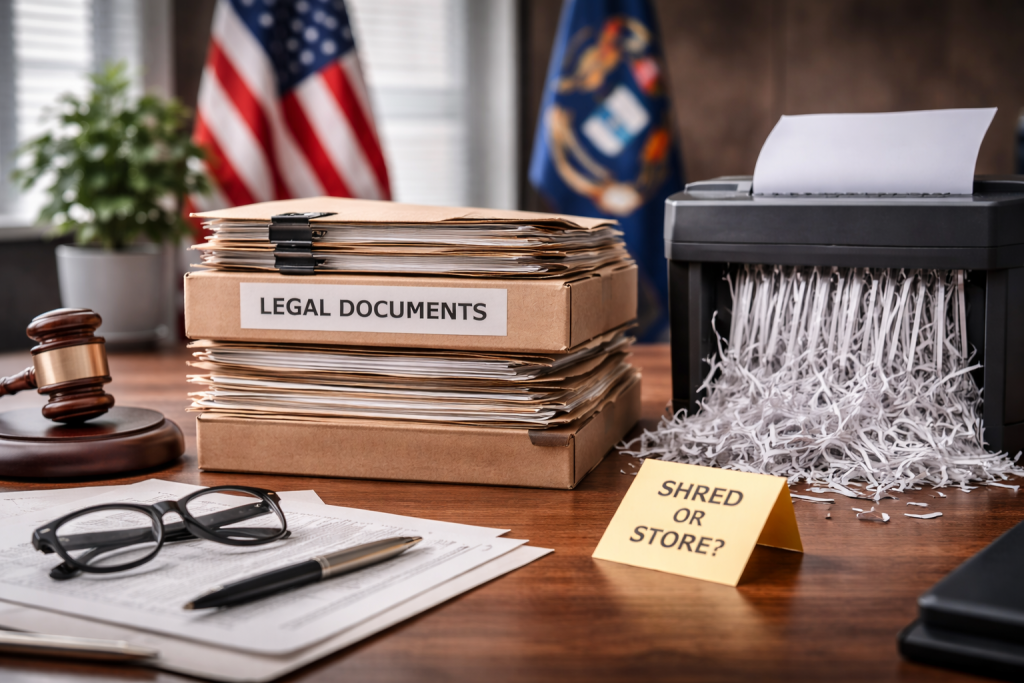
Law firms are built on confidentiality.
Clients share their most sensitive information — financial situations, family disputes, criminal history, business dealings — with the expectation that it will be handled with care.
That obligation doesn’t end when a case closes.
It extends to how long client files are kept, how they’re stored, and how they’re eventually destroyed.
Most law firms have a strong intake process. Far fewer have an equally strong plan for what happens to files on the back end.
Why Law Firm Records Management Is Different
Law firms face a unique set of challenges that most other businesses don’t.
Client files can span decades. A real estate transaction file might need to be referenced years after closing. A probate file may be relevant long after the estate is settled. Litigation files sometimes resurface when a case is appealed or a related claim is filed.
At the same time, storing everything forever isn’t realistic — or safe.
File rooms fill up. Offsite storage costs accumulate. The longer files sit around, the longer sensitive client information is at risk of being accessed by the wrong person or damaged by fire, flood, or deterioration.
Law firms need a structured approach — one that balances access with security and compliance with practicality.
What the Michigan Rules Say
The Michigan Rules of Professional Conduct require attorneys to keep client files for a reasonable period after the conclusion of a representation — but “reasonable” isn’t a fixed number.
In practice, most Michigan attorneys follow a general guideline of 7 to 10 years for most client files, with some categories retained longer:
- Estate planning and probate files — many attorneys keep these indefinitely or until confirmed the client has passed and all matters are resolved
- Real estate transaction files — minimum 7 years; longer if ongoing client relationship
- Corporate and business formation records — often kept permanently or for the life of the entity
- Litigation files — typically 7 years after final resolution; longer for matters involving minors
- Criminal defense files — many attorneys retain these indefinitely given the potential for post-conviction proceedings
- Trust and fiduciary records — minimum 7 years after termination of the trust
These are guidelines, not hard rules. Your firm’s retention policy should be developed with your professional liability carrier and legal ethics counsel.
What’s clear is that files can’t simply be thrown out when you’re done with them — and they can’t sit in unlocked filing cabinets indefinitely either.
The Risk of Improper File Disposal
When a law firm disposes of client files improperly, the consequences go beyond regulatory discipline.
A competitor, identity thief, or opposing party recovering client documents from a dumpster or recycling bin could expose clients to harm — and expose the firm to malpractice claims, bar complaints, and civil liability.
It doesn’t take a sophisticated attack. Improperly discarded paper files are one of the oldest and simplest forms of information theft.
Certified shredding with a documented Certificate of Destruction is the only way to prove that client files were destroyed securely and that the firm met its duty of confidentiality through the end of the file’s lifecycle.
Common Records Management Problems at Law Firms
- No formal retention schedule — Without a written policy, retention decisions are made case by case — usually inconsistently. Some files get kept for 20 years. Others get tossed after 2. Neither approach is defensible.
- File rooms that haven’t been reviewed in years — Many law firms have storage rooms or offsite boxes full of files that nobody has touched in a decade. Without a retention schedule, those files just accumulate — increasing storage costs and liability.
- Client notification gaps — Michigan attorneys are generally expected to notify clients before destroying files and to give them an opportunity to retrieve their documents. Many firms skip this step, which creates its own professional liability exposure.
- No chain of custody for destruction — If a bar complaint or malpractice claim ever questions how a client’s file was handled, a Certificate of Destruction from a NAID AAA Certified provider is the clearest way to demonstrate that your firm met its obligations.
- Ignoring digital files — Electronic case files, email correspondence, and scanned documents carry the same confidentiality obligations as paper records. When old computers, servers, or backup drives are retired, physical hard drive destruction is required — not just deletion.
What a Strong Law Firm Records Program Includes
A written retention policy — Document retention periods by matter type. Define who is responsible for managing the schedule. Review and update it annually.
Client notification procedures — Before destroying any client file, your firm should have a documented process for notifying the client and offering file retrieval.
Secure offsite storage for inactive files — Files past their active phase but not yet ready for destruction should be stored securely — not in a back office or an unsecured storage unit. A professional records facility offers barcode tracking, controlled access, and fast retrieval when needed.
Document scanning for active and semi-active files — Scanning frequently accessed files reduces physical storage needs and makes documents easier to share securely with clients and co-counsel.
Certified destruction at end of retention period — When a file reaches the end of its retention period, it should be shredded by a NAID AAA Certified provider. Every destruction job should produce a Certificate of Destruction that becomes part of your firm’s records.
How Corrigan Supports Michigan Law Firms
Corrigan Record Storage has provided secure records management services to law firms across Southeast Michigan for over 30 years.
Services for law firms include:
- Secure offsite document storage with barcode tracking and fast retrieval
- Scan-on-demand — request a digital copy of any stored file without physical delivery
- Document scanning services to convert paper files to searchable digital records
- NAID AAA Certified shredding with Certificate of Destruction for every job
- Hard drive and digital media destruction for retired computers and servers
- Scheduled shredding programs to keep file destruction on track throughout the year
Corrigan understands the confidentiality requirements law firms operate under — and builds every program around those obligations.
The Bottom Line
Client confidentiality doesn’t end when a case is closed.
It extends through storage, through the retention period, and through the moment of destruction.
Law firms that treat records management as an afterthought are taking on unnecessary risk — to their clients, their reputation, and their practice.
A structured records program protects everyone. And it’s easier to implement than most firms expect.
Ready to Get Your Law Firm’s Records Under Control?
Corrigan Record Storage provides secure document storage, scanning, and NAID AAA Certified shredding for law firms across Southeast Michigan.
Contact Corrigan today to build a records management program that meets your professional obligations and protects your clients.
Call 248-344-9185 or visit corriganrecords.com to request a quote.